Also called broad-leaved plantain, great plantain, plantain, dooryard plantain, doorweed, Englishman's-foot, white man's footprint, cart track plant, ripple grass
Not the banana! This page is about a common lawn weed, Plantago major. It is not related to the starchy, banana-like fruit also called "plantain" [1].
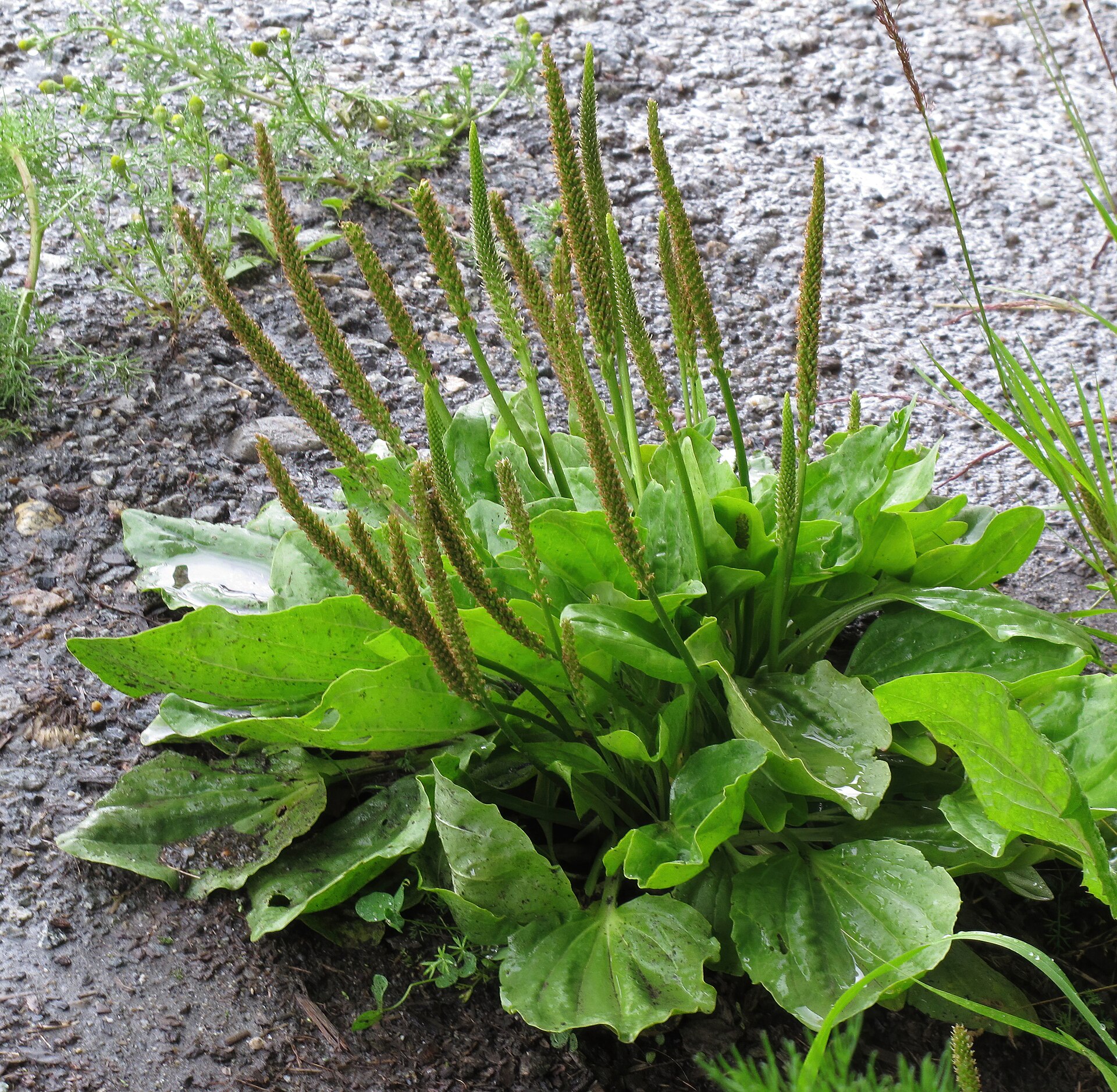
Broadleaf plantain is a tough, low-growing weed with a flat rosette of broad, ribbed leaves and slender spikes of tiny flowers. It's native to Eurasia and spread around the world with European settlers [1][3]. It thrives in lawns, fields, roadsides, and hard-packed ground, and it survives being walked on and mowed [1]. Its young leaves are a nutritious wild green [1].
For centuries, people almost everywhere have pressed its leaves onto wounds, stings, and sores [2]. Lab studies show activities that could fit some of its traditional uses, and a few small clinical trials of plantain preparations on wounds look promising. But the evidence is still early, and no trial we found tested the classic fresh-leaf poultice on bites or stings[2][4][5][6].
Quick facts
Specimen · Plantaginaceae
Botanical name
Plantago major L.
Family
Plantaginaceae (plantain family)
Other names
broad-leaved plantain, great plantain, plantain, dooryard plantain, doorweed, Englishman's-foot, white man's footprint, cart track plant, ripple grass
❦
Names
Common names: broad-leaved plantain, great plantain, plantain, dooryard plantain, doorweed, Englishman's-foot, cart track plant, and ripple grass [1].
Where the name comes from: Native Americans called it "white man's footprint," because it appeared and thrived around European settlements [1][3].
Not the same as: the cooking "plantain," which is a type of banana [1]. Also not the same as psyllium, the fiber supplement, which comes mainly from the seeds of other Plantago species such as P. ovata[3].
❦
Traditional uses
This section describes how people have used broadleaf plantain historically. It does not show that these uses work. See the next section for the evidence.
Wounds and skin: the leaves have been used to heal wounds "for centuries in almost all parts of the world" [2]. Traditional uses include bites, stings, cuts, sore feet, and problems of the eyes, tongue, and mouth [1]. Fresh leaves have been poulticed onto sores, ulcers, boils, and infections, and onto insect bites [3].
Poison ivy: an old report describes crushed leaves used on poison ivy rash in 10 people. It was not a scientific trial [3].
Other uses: the leaves have also been used for respiratory, digestive, reproductive, and circulatory problems, for pain, against infections, and against cancer [2].
A related plant: European regulators accept the leaf of a close relative, ribwort or narrowleaf plantain (Plantago lanceolata), as a traditional remedy for a sore throat with dry cough, cough with a cold, and minor skin inflammation [7]. That acceptance doesn't cover broadleaf plantain.
Food: young leaves are eaten raw or cooked like spinach. Older, stringier leaves are boiled in stews. The seeds are edible too [1].
❦
What the evidence says
Bottom line: early and limited. Lab studies show several potentially useful activities, but human trials are few and small, and none has been repeated [2][4][5][6][8].
Use
What was found
Strength
Lab activity
Extracts showed wound-healing, anti-inflammatory, pain-relieving, antioxidant, weak antibiotic, and immune effects in lab studies [2].
Lab only
Wound healing in animals
A 2021 systematic review found only 4 animal studies, all at high risk of bias. It "did not find evidence" that plantain heals wounds in living animals [4].
Weak and low-quality
Diabetic foot and pressure ulcers
In an open-label trial (94 people completed it), a 10% plantain leaf gel plus routine care healed ulcers faster than a modern dressing [5]. In a 130-patient trial on early-stage pressure sores, a plantain cream outperformed the control [6].
Single small trials, not repeated
Mouth sores from radiation
In 46 people with head and neck cancer, a plantain syrup reduced the severity and pain of radiation mouth sores compared with placebo [8].
One small trial
Insect bites and stings
We found no clinical trials. This use rests on tradition [1][3].
No human evidence
What we can't say: that a fresh plantain leaf heals cuts, draws out splinters or venom, or treats bee stings. These popular claims haven't been tested in people. The trials above used prepared gels, creams, and syrups on medical wounds, not leaves from the lawn [5][6][8].
❦
How it’s used / prepared
This is general, traditional information, not a recommendation or a dose for you. See a health professional for any wound that is deep, dirty, or infected, or if you have diabetes.
Parts used: mainly the leaves. The seeds are also edible [1].
On the skin (traditional): fresh leaves crushed or chewed and applied as a poultice to minor bites, stings, and scrapes [1][3]. This is folk practice, not a tested treatment.
Food: young, tender leaves are eaten raw. Older leaves are cooked [1]. Plantain is rich in calcium and vitamins A, C, and K [1].
Tea: Drugs.com lists 3–6 g a day of dried ribwort plantain (P. lanceolata) leaf as a tea for respiratory infections [3]. We didn't find a regulatory monograph for broadleaf plantain tea.
Where to pick: plantain loves roadsides and disturbed ground [1]. Mississippi State Extension advises against foraging in places where herbicides, pesticides, heavy metals, or industrial runoff may be present, such as roadsides, power-line corridors, and industrial zones [9]. Pick from a yard or field you know hasn't been sprayed.
When to stop and get help: if a wound gets red, swollen, warm, or painful, or a sting causes swelling of the face or trouble breathing, get medical care right away.
❦
How to identify
Broadleaf plantain is a great first plant to learn, but learn it with someone experienced, and check every feature below.
Leaves: all grow from the base in a flat rosette. They are broadly lance-shaped to egg-shaped, 2–8 inches long and 2–4 inches wide [1].
Veins:5–7 strong, parallel veins run from the base of the leaf to the tip. If you gently pull a leaf stalk apart, the veins show as stringy threads [1].
Leaf surface: medium green and smooth to sparsely hairy on top; lighter and finely hairy along the veins underneath [1].
Flowers: tiny greenish-brown flowers with white to purple stamens, packed into narrow, cylindrical spikes on leafless, unbranched stalks less than 12 inches tall [1].
Seeds: small, glossy brown seeds form all along the spike. Each plant can make about 20,000 seeds [1].
Broadleaf plantain has no dangerous look-alikes in our verified sources. NC State Extension lists three plants that are often confused with it [1]:
Ribwort or narrowleaf plantain (Plantago lanceolata)
A close relative and also an edible weed [11]. Its leaves are long and narrow (lance-shaped) and parallel-veined, not broad and oval. Its flower stalks are slightly furrowed [11].
A small native ground cover in the daisy family, 4–6 inches tall [12].
How it differs: its leaves are woolly gray-green, densely hairy underneath, and smooth-edged. Its flowers are fuzzy, white, tufted heads, not slender green spikes [12].
Downy rattlesnake plantain (Goodyera pubescens)
A native woodland orchid, "not a weed nor a plantain," according to NC State Extension [13].
How it differs: dark green to bluish-green leaves with a striking network of white veins. It grows in woodlands, not lawns, and its downy flower stalk has 20–50 small white flowers [13].
Food use: the young leaves are a traditional wild green [1].
Large amounts: NC State Extension notes that eating large quantities can lower blood pressure [1]. Plantain extract lowered blood pressure in dogs [3]. If you take blood pressure medicine, don't eat large amounts without checking with your doctor.
Allergy: pollen from the related ribwort plantain is a known cause of seasonal allergies [3]. Anyone who has reacted to plantain should avoid it.
Pregnancy and breastfeeding: we found no safety data for broadleaf plantain leaf. Drugs.com's monograph on the Plantago group, which is mostly about psyllium, advises avoiding it in pregnancy [3]. NIH LactMed has no entry for plantain leaf (it covers psyllium only). Food amounts aside, ask your health care provider first.
Medication interactions: we found no well-documented interactions for broadleaf plantain leaf. That's a gap in the research, not proof of safety. Psyllium, the seed fiber, has its own interactions and cautions, and they don't automatically apply to the leaf [3].
Children: we found no safety data on medicinal use in children.
Topical use: no side effects were found with the plantain cream in the pressure-sore trial [6].
Pets: we found no verified pet-toxicity information for broadleaf plantain.
Not medical advice
This page is for general education only. It is not medical advice and doesn't replace a doctor, pharmacist, or other qualified professional. Herbs can cause allergic reactions and interact with medicines. Check with a health professional before using any herb, especially if you are pregnant or breastfeeding, giving it to a child, taking medication, or managing a health condition. Never eat or use a wild plant unless an expert has confirmed what it is. For a suspected poisoning in the U.S., call Poison Help at 1-800-222-1222 [10]. In Canada, call 1-844-POISON-X (1-844-764-7669), or the Centre antipoison du Québec at 1-800-463-5060 if you are in Québec [14].
Samuelsen AB. The traditional uses, chemical constituents and biological activities of Plantago major L. A review. J Ethnopharmacol. 2000. https://pubmed.ncbi.nlm.nih.gov/10904143/
Cardoso FCI, Breder JC, Apolinário PP, et al. The effect of Plantago major on wound healing in preclinical studies: a systematic review. Wound Manag Prev. 2021. https://pubmed.ncbi.nlm.nih.gov/33448940/
Ghanadian M, Soltani R, Homayouni A, et al. The effect of Plantago major hydroalcoholic extract on the healing of diabetic foot and pressure ulcers: a randomized open-label controlled clinical trial. Int J Low Extrem Wounds. 2024. https://pubmed.ncbi.nlm.nih.gov/35044254/
Ghiasian M, Niroomandi Z, Dastan D, et al. Clinical and phytochemical studies of Plantago major in pressure ulcer treatment: a randomized controlled trial. Complement Ther Clin Pract. 2021. https://pubmed.ncbi.nlm.nih.gov/33548748/
Soltani GM, Hemati S, Sarvizadeh M, et al. Efficacy of the Plantago major L. syrup on radiation induced oral mucositis in head and neck cancer patients: a randomized, double blind, placebo-controlled clinical trial. Complement Ther Med. 2020. https://pubmed.ncbi.nlm.nih.gov/32507421/
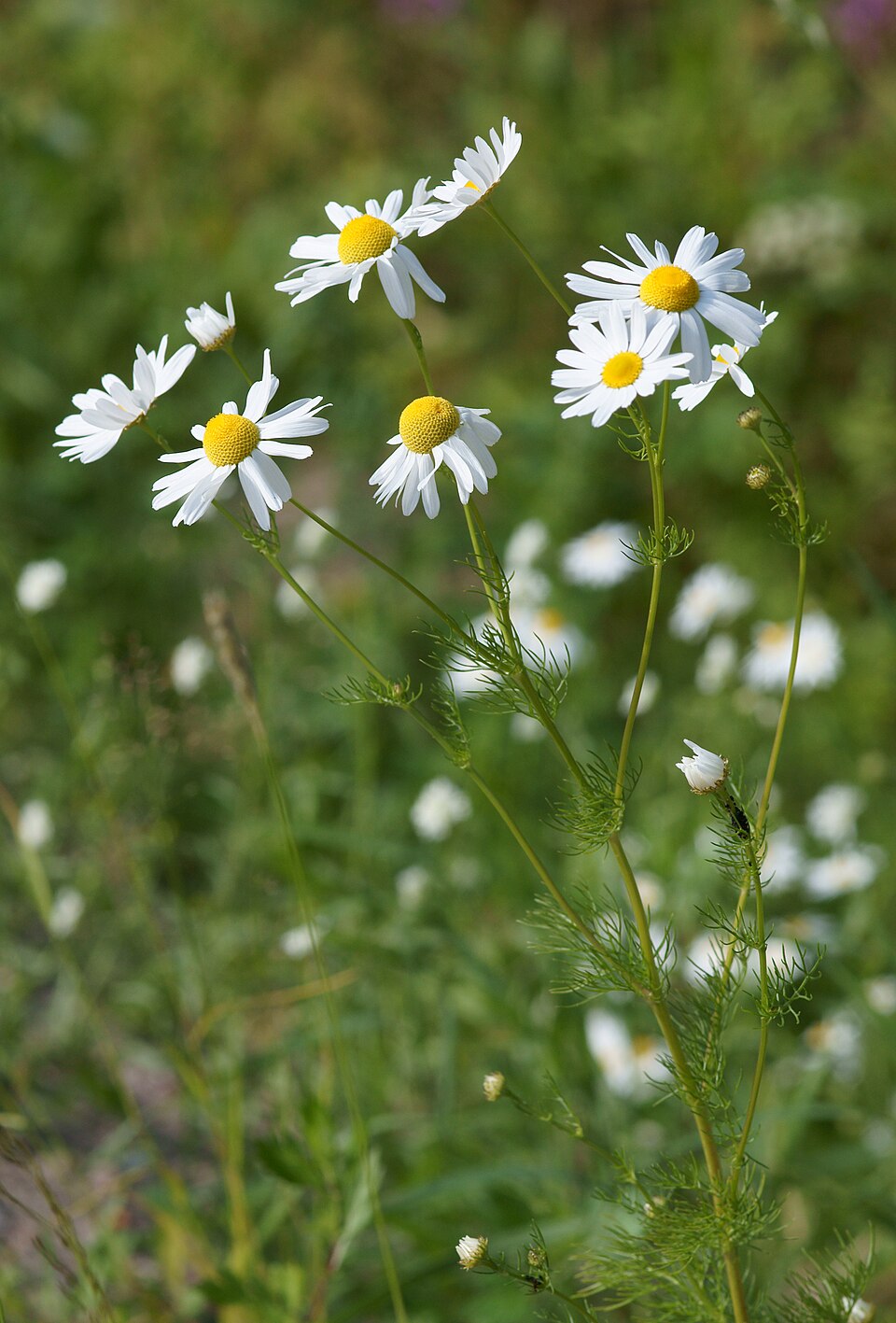
German chamomile is a small, sweet-smelling annual with feathery leaves and little daisy-like flowers that have white petals and a domed yellow center.