Also called chamomile, German chamomile, annual chamomile, sweet false chamomile, matricaria flower
Safety noteLast reviewed
Photo: Rob Hille, public domain, via Wikimedia Commons
Overview
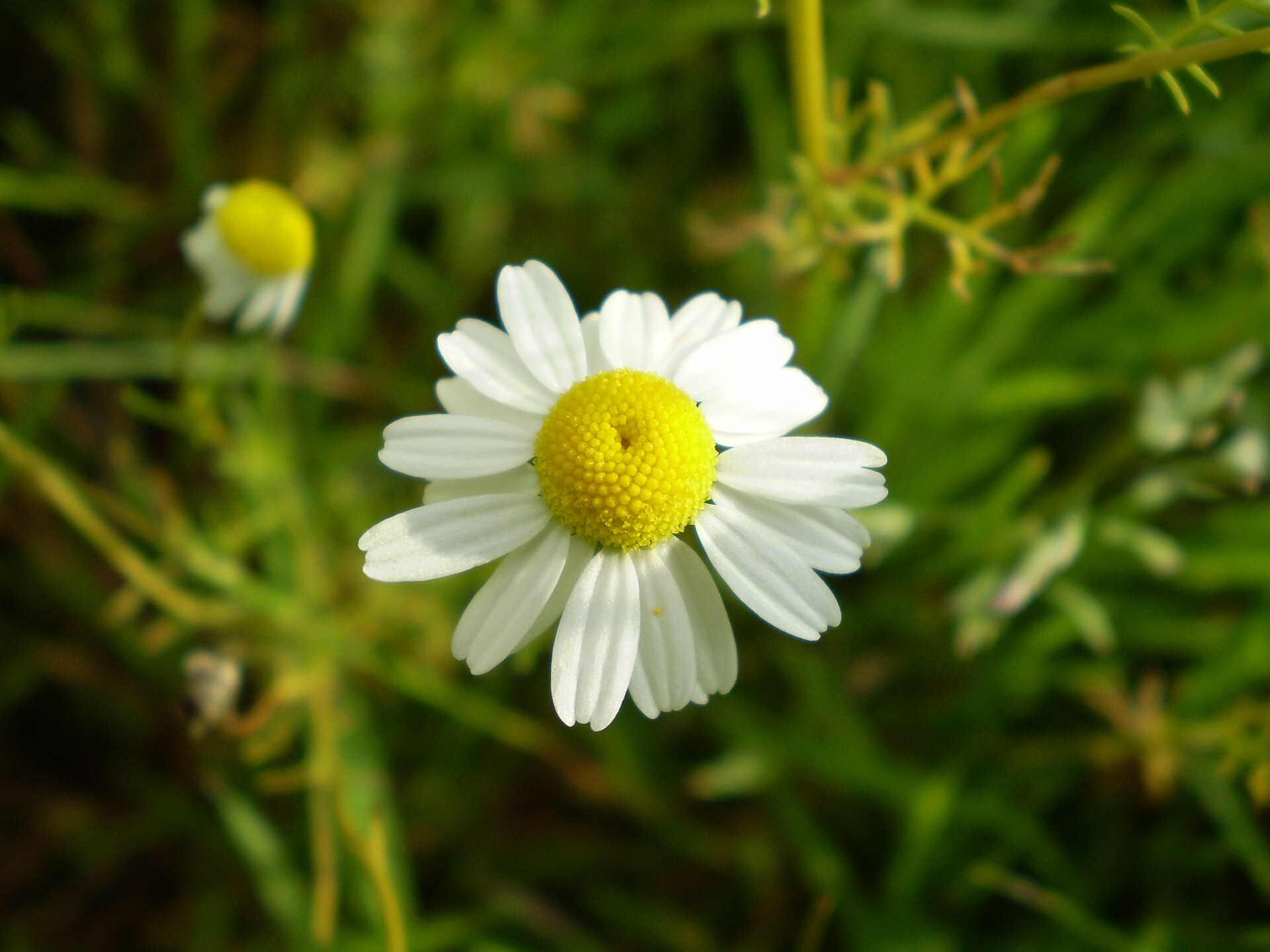
German chamomile is a small, sweet-smelling annual with feathery leaves and little daisy-like flowers that have white petals and a domed yellow center. It is one of the world's most popular herbal teas [3]. It is native to Europe and western Asia and has been introduced to North America, where it grows in gardens and turns up in disturbed ground, fields, and meadows [2][3].
Chamomile tea is a gentle, familiar drink, but the science behind its health uses is thin. The NIH's National Center for Complementary and Integrative Health (NCCIH) says studies "have not produced sufficient reliable evidence to rate clinical usefulness" [1]. The most promising human research is on a chamomile extract for generalized anxiety disorder. For sleep, the evidence is mixed [1][5][6].
Quick facts
Specimen · Asteraceae
Botanical name
Matricaria chamomilla L. (syn. Matricaria recutita L., Chamomilla recutita)
Family
Asteraceae (daisy / aster family)
Other names
chamomile, German chamomile, annual chamomile, sweet false chamomile, matricaria flower
❦
Names
Common names: chamomile, German chamomile, annual chamomile, sweet false chamomile [1][2][3]. European regulators call the dried flower heads "matricaria flower" [4].
Botanical name:Matricaria chamomilla L. You'll also see it listed as Matricaria recutita or Chamomilla recutita[1][3].
Family: Asteraceae, the daisy family. Ragweed, chrysanthemums, marigolds, and daisies are relatives, which matters for allergies [1].
Not the same as Roman chamomile: Roman (or English) chamomile is a different plant, Chamaemelum nobile. It's a low, creeping perennial with a more bitter taste and is used less often for tea [3]. This page covers German chamomile.
Where the name comes from:chamomilla comes from two Greek words meaning "earth apple," after the plant's apple-like scent [2].
❦
Traditional uses
This section describes how people have used chamomile historically. It does not show that these uses work. See the next section for the evidence.
An ancient remedy: chamomile appears in ancient medical writings. It was an important medicinal herb in ancient China, Egypt, Greece, and Rome [1].
Digestion: it has long been used for minor stomach and gut complaints such as bloating and mild cramps. European regulators recognize this as a traditional use [4][7].
Colds: inhaling the steam of a hot chamomile infusion is a traditional way to ease cold symptoms [4][7].
Mouth and throat: chamomile infusions are used as rinses and gargles for minor mouth sores and irritation [4][7].
Skin: washes and compresses are used for minor skin inflammation such as sunburn, superficial wounds, and small boils [4][7].
Calm and sleep: the tea has long been thought to have a sedating effect [2].
❦
What the evidence says
Bottom line: the evidence is limited. There are a few promising small studies, mainly on anxiety, but no strong proof for any single use. NCCIH says chamomile studies "have not produced sufficient reliable evidence to rate clinical usefulness." Some studies test chamomile mixed with other herbs, which makes chamomile's own role hard to judge [1]. European regulators approve chamomile medicines only on the basis of traditional use. They found the clinical studies they reviewed too weak to count as evidence, partly because the studies didn't compare chamomile with any other treatment [4].
Use
What was found
Strength
Generalized anxiety disorder (GAD)
In a U.S. trial, 179 adults took a pharmaceutical-grade chamomile extract (capsules) for 12 weeks. The 93 who responded were then randomly assigned to keep taking it or switch to placebo for 26 weeks. The chamomile group kept lower anxiety scores, but the drop in relapses did not reach statistical significance [8]. A 2019 meta-analysis found improvement in GAD scores after 2 and 4 weeks [5].
Preliminary but promising. These are extract capsules, not tea. NCCIH calls the studies "preliminary" [1].
Only one trial was found, and it showed no benefit [1][5].
Very little evidence
Sleep quality
Two meta-analyses found modest improvements in self-reported sleep quality [5][6]. The 2024 review (10 studies, 772 people) found fewer night-time awakenings but no change in sleep length, sleep efficiency, or daytime functioning [6].
Low to moderate. The studies varied a lot, and most outcomes were self-reported [6].
Mouth sores from cancer treatment
Small studies suggest chamomile mouthwashes might help prevent or treat mouth irritation from radiation, chemotherapy, or stem cell transplant [1].
Small studies only
Infant colic and children's diarrhea
Some multi-herb products that include chamomile helped, but chamomile alone has not been shown to help [1].
Not shown for chamomile alone
What we can't say: that chamomile tea treats insomnia, that it is a proven treatment for anxiety, or that it treats colds, colic, or skin conditions. None of these has good evidence in people [1][4][5].
❦
How it’s used / prepared
This is general, traditional information, not a recommendation or a dose for you. Talk with a health professional before using chamomile for a health purpose.
Tea (infusion): the usual form. The EU traditional-use monograph describes infusions made by pouring boiling water over a small amount (a few grams) of dried flowers [7].
Steam inhalation: for cold symptoms, the monograph describes inhaling steam from a hot chamomile infusion [4][7]. Take care with hot water, especially around children.
Mouth rinse or gargle: a cooled infusion used for minor mouth and throat irritation [4][7].
On the skin: washes, compresses, and baths for minor skin inflammation. Full baths are not advised for people with open wounds, large skin injuries, acute skin disease, high fever, severe infections, or serious heart or circulation problems [4][7].
Liquid extracts and tinctures: these exist too, and many contain alcohol [7].
When to stop and get help: EU guidance says to see a doctor or qualified practitioner if symptoms last more than a week or get worse [4].
Children: the EU monograph covers some preparations for children but says others haven't been established as safe under age 12. Infant use of the tea isn't covered under 6 months [7]. Ask a pediatrician first.
❦
How to identify
German chamomile is easy to grow from seed in a sunny garden, and most people buy it dried [2][3]. If you grow it or come across it, these are the features to check:
Leaves: feathery and finely divided, with thread-like segments. They are smooth, 0.5–3 inches long, sparse along the stem, and smell aromatic but taste bitter [2][3].
Flowers: daisy-like heads 0.5–1 inch across, with 10–25 white petals (ray flowers) around a yellow center that starts button-shaped and becomes domed or cone-shaped as it matures [2][3]. A key feature: the center (receptacle) is hollow if you slice the flower head in half [2][3].
Stems: light green to purplish-green, upright, and branching near the top. The plant grows up to about 2 feet tall [2][3].
Smell: a strong, sweet, apple-like fragrance [2][3].
Habitat: full sun and well-drained, even poor, soil. It also grows in disturbed ground, roadsides, fields, and meadows [2][3].
Season: an annual that blooms from early or midsummer into fall (about June to October) [2][3].
Buying dried chamomile: look for the botanical name (Matricaria chamomilla or M. recutita) on the label. U.S. dietary supplements are not approved by the FDA before they are sold, and products don't always contain what the label says [1][9]. Some products are checked by independent testing organizations, but that verifies quality, not safety or effectiveness [9].
❦
Look-alikes to avoid
When in doubt, don't.
If any feature doesn't match, or you can't check all of them, leave the plant alone.
Many small white-and-yellow daisy-family plants are called "chamomile." Most aren't deadly, but some are unpleasant or irritating, and Wisconsin Extension notes that some Anthemis look-alikes are poisonous [3]. All of them are daisy-family plants, so they carry the same allergy risk.
Mayweed / stinking chamomile (Anthemis cotula)
Looks very similar, with white petals and a yellow center, but has a repulsive smell when crushed [3][11].
The center of the flower head is filled (solid), not hollow [3].
Some Anthemis species are poisonous [3]. Don't use it for tea.
A close relative and a common North American weed of roadsides and gardens [3][11].
Has no white petals. The flower heads are just greenish-yellow cones [3][11].
It smells strongly of pineapple when crushed [3][11].
Feverfew (Tanacetum parthenium), which is sometimes also called "wild chamomile" [12]
The flowers look similar, about ¾ inch across with white petals and a yellow button center. The petals have 3 small teeth at the tip[12].
The leaves are much broader: toothed, roughly oval, 1.5 to more than 4 inches long, and slightly hairy underneath. Chamomile's leaves are thread-like [2][12].
It's a perennial that grows 1–3 feet tall in mounds, with a strong scent [12].
Feverfew can occasionally cause skin reactions [12].
Roman chamomile (Chamaemelum nobile)
A low, creeping perennial ground cover with a more bitter taste [3][13]. It's also used for tea, but it's a different plant with its own research, so don't assume this page applies to it.
Daisy-family (Asteraceae) allergy: don't use chamomile if you're allergic to it or to related plants such as ragweed, chrysanthemums, marigolds, or daisies [1][4]. Reactions are uncommon but can be severe, including anaphylaxis [1]. LactMed notes possible cross-reactions with echinacea, feverfew, and milk thistle [9].
Skin and eyes: chamomile used on the skin can cause allergic sensitization [9]. Used near the eyes, it may cause irritation [1].
Common side effects: they're uncommon but can include nausea and dizziness [1].
Hormone effects: chamomile might act somewhat like estrogen. Preliminary studies suggest it might reduce the effect of birth control pills, and it might worsen estrogen-sensitive conditions such as breast or uterine cancer [1].
Medication interactions: interactions with warfarin (a blood thinner) and some drugs processed by the liver have been reported. Interactions with sedatives are possible in theory [1]. If you take any medicine, ask your pharmacist first.
Pregnancy: little is known about safety in pregnancy [1]. EU guidance does not recommend medicinal use in pregnancy because there isn't enough data [7].
Breastfeeding: there's no data on safety in nursing mothers or infants. The small amounts expected in breast milk are probably not harmful at usual doses [9]. Don't put chamomile on the nipples, because it has caused skin reactions there [9]. LactMed also notes that Clostridium botulinum (botulism) spores have been found in some loose-leaf chamomile teas sold in health food stores [9].
Food amounts: chamomile is likely safe in the amounts found in teas and foods [1].
Pets: NC State Extension lists German chamomile as toxic to dogs, cats, and horses [2].
Not medical advice
This page is for general education only. It is not medical advice and doesn't replace a doctor, pharmacist, or other qualified professional. Herbs can cause allergic reactions and interact with medicines. Check with a health professional before using any herb, especially if you are pregnant or breastfeeding, giving it to a child, taking medication, or managing a health condition. Never eat or use a wild plant unless an expert has confirmed what it is. For a suspected poisoning in the U.S., call Poison Help at 1-800-222-1222 [10]. In Canada, call 1-844-POISON-X (1-844-764-7669), or the Centre antipoison du Québec at 1-800-463-5060 if you are in Québec [14].
Hieu TH, Dibas M, et al. Therapeutic efficacy and safety of chamomile for state anxiety, generalized anxiety disorder, insomnia, and sleep quality: a systematic review and meta-analysis. Phytother Res. 2019. https://pubmed.ncbi.nlm.nih.gov/31006899/
Kazemi A, Shojaei-Zarghani S, et al. Effects of chamomile (Matricaria chamomilla L.) on sleep: a systematic review and meta-analysis of clinical trials. Complement Ther Med. 2024. https://pubmed.ncbi.nlm.nih.gov/39106912/
Mao JJ, Xie SX, Keefe JR, et al. Long-term chamomile (Matricaria chamomilla L.) treatment for generalized anxiety disorder: a randomized clinical trial. Phytomedicine. 2016. https://pubmed.ncbi.nlm.nih.gov/27912875/