Lavender is an aromatic, evergreen shrub native to the Mediterranean region, including France, Spain, Andorra, and Italy [1]. In North America it is a garden plant, not a native wildflower. English lavender forms a mound up to about 2 feet tall and 3 feet wide and needs full sun and very well-drained soil [2]. It is the source of "true oil of lavender" [2].
Lavender is studied more than most garden herbs. The strongest evidence is for one specific lavender-oil capsule (Silexan) taken by mouth for anxiety[7][8][9]. NCCIH says the research has limitations, including small studies, lack of independent funding, and little diversity among participants [1]. For aromatherapy (smelling lavender), sleep, and other uses, the evidence is less clear [1]. European regulators accept lavender flower and lavender oil as traditional medicines for mild stress, exhaustion, and to help with sleep, based on long use [3][10].
Quick facts
Specimen · Lamiaceae
Botanical name
Lavandula angustifolia Mill.
Family
Lamiaceae (mint family)
Other names
English lavender, common lavender, narrow-leaved lavender
❦
Names
Common names: lavender, English lavender, common lavender, narrow-leaved lavender [1][2]
Watch the common names: "French lavender" is used for several different plants. NCCIH lists it as a name for L. angustifolia[1], NC State Extension uses it for L. stoechas[4], and UC Master Gardeners use it for L. dentata[5]. Always check the botanical name on the label. See Look-alikes to avoid.
Where the name comes from: "lavender" comes from the Latin lavare, "to wash," because the scent has long been used in bath products, perfumes, and washes [1][6].
❦
Traditional uses
This section describes how people have used lavender historically. It does not show that these uses work. See the next section for the evidence.
Calm and sleep: lavender has traditionally been used for anxiety, insomnia, and other nervous-system complaints, often as aromatherapy [15]. The EU's traditional-use monographs list relief of mild symptoms of mental stress and exhaustion, and help with sleep [3][16].
Washing and fragrance: its scent has long been used in bath products, perfumes, and aromatherapy [1].
Infections and pain: traditional uses have included infections, pain, and many other conditions [15].
Persian medicine: lavender is one of the herbs most often mentioned for mental disorders in traditional Persian texts [17].
Household and craft uses: potpourri, herb pillows, crafts, vinegars, and jellies [2].
❦
What the evidence says
Bottom line: moderate evidence for one oral lavender-oil product for anxiety. For everything else, it's weak or unclear. NCCIH says "more high-quality research is needed to reach reliable conclusions" [1]. The European Medicines Agency approves lavender only for traditional use. It noted that studies showed possible effects on anxiety, stress, and insomnia, but had too few patients to establish an effect [10].
What has been studied:
Use
What was found
Strength
Anxiety (oral lavender oil capsules, Silexan)
In a 10-week trial of 539 adults with generalized anxiety disorder, Silexan (80 or 160 mg a day) reduced anxiety scores more than placebo. Side-effect rates were similar to placebo [7]. A 2019 review of 5 trials reached a similar conclusion [9].
Moderate, for this product only. NCCIH notes small samples, a lack of independent funding and testing, and little participant diversity [1].
Anxiety (smelling lavender, massage)
A 2019 review of 65 randomized trials found that inhaled lavender and lavender-oil massage lowered anxiety scores. Most trials had a high risk of bias, and the designs varied widely [8].
Weak. Lots of studies, but mostly low quality.
Depression symptoms
A 2021 review of 17 trials found lower depression scores with lavender, but the authors called for larger, more rigorous trials [17]. NCCIH calls the research preliminary and says lavender on the skin doesn't seem to help depression [1].
Weak and preliminary.
Sleep and insomnia
NCCIH says it's unclear whether lavender aromatherapy helps sleep quality or insomnia [1]. The EMA found too few patients in the studies to establish an effect [10].
Unclear.
Pain, menopause symptoms, cough
NCCIH lists single small or preliminary studies, for example a 72-woman study on menopause-related sexual problems and one study of lavender syrup for cough in COVID-19 [1].
Very preliminary.
What we can't say: there is no good evidence that lavender treats depression, anxiety disorders, or insomnia as a replacement for medical care. Results from one standardized capsule don't apply to lavender tea, sachets, or essential oils sold in stores [1][15]. Depression can be serious. If you or someone in your family may have depression, talk with a health care provider [1].
❦
How it’s used / prepared
This is general, traditional information, not a recommendation or a dose for you. Talk with a health professional before using lavender for a health purpose.
Parts used: the dried flowers, and the essential oil steam-distilled from the flowering tops [3][10].
Tea (infusion): the EU traditional-use monograph describes 1–2 grams of dried lavender flower in 150 ml (about ⅔ cup) of boiling water, up to 3 times a day, for people 12 and older [3].
Tincture: the monograph also describes a lavender flower tincture [3]. Tinctures contain alcohol [3].
Lavender oil by mouth: the EU monograph on lavender oil describes small, measured amounts (20–80 mg a day) in finished medicinal products for people 12 and older [16]. Don't swallow essential oil from a bottle. Lavender oil is toxic if swallowed, and very small amounts can cause severe sleepiness in children [11].
Bath: the monograph describes 1–3 grams of lavender oil per full bath [16]. Full baths are not for people with open wounds, large skin injuries, acute skin disease, high fever, severe infection, or serious heart or circulation problems [10][16].
Aromatherapy: inhaling lavender oil is considered possibly safe but can cause headache or coughing [1].
As food: lavender in food amounts is likely safe [1], and the U.S. FDA lists lavender, and lavender oil as a flavoring, as "generally recognized as safe" [15][18][19]. For cooking, UC Master Gardeners recommend English lavender, used sparingly [5].
When to stop and get help: in the EU guidance, see a doctor if symptoms persist or get worse [3][16].
❦
How to identify
Lavender is a garden and store herb, so you don't need to forage it. The important skill is telling the types of lavender apart.
Plant: English lavender is a broad, mounded dwarf shrub about 1–2 feet tall and 2–3 feet wide [2].
Leaves: narrow (linear to lance-shaped), about 0.4–1 inch long, gray-green to bluish-green, soft and velvety, with edges that roll under. They grow in opposite pairs and smell sweet when bruised [2].
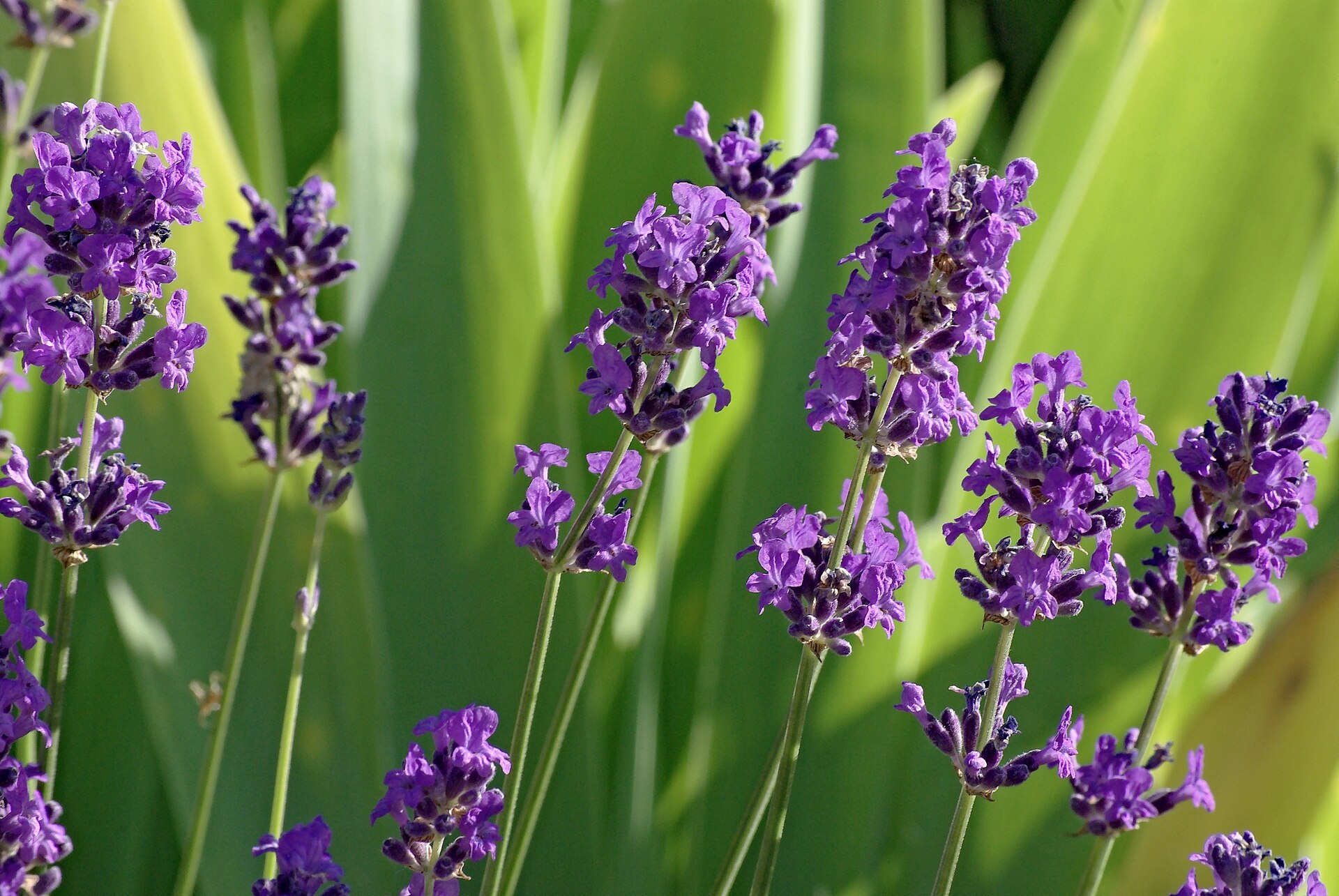
Flowers: small, two-lipped, usually lavender-purple (sometimes pink or white) flowers in a spike at the end of a long, bare stalk [2]. English lavender blooms in early summer and sometimes again later in the season [5].
Lavender has no deadly look-alikes in the garden. The real issue is that several different lavenders are sold, and they have different chemistry and uses.
Lavandin (Lavandula × intermedia): not toxic, but different
What it is: a hybrid of English lavender and Portuguese or spike lavender (L. latifolia) [5][6].
How to tell: a larger plant (2–4 feet), longer flower spikes, and later bloom (about July to September) than English lavender [6][21].
Why it matters: lavandin oil has much more camphor than English lavender oil: about 6–10% vs 0–0.6% [21]. It is mostly used for body and home products, such as commercial fragrances, soaps, and detergents, rather than cooking [5][21].
Spanish lavender (Lavandula stoechas; also sold as "French" or "butterfly" lavender)
How to tell: short, dense flower heads topped with showy petal-like bracts that look like "rabbit ears" or flags [4][5].
Why it matters: UC Master Gardeners say it is not recommended for cooking because of its high camphor content and bitter taste [5]. It is less cold-hardy (zones 8–9) [4].
French lavender (Lavandula dentata)
How to tell: leaves with toothed edges, and smaller bracts at the top of the flower spike [5].
Why it matters: its camphor-like scent makes it better suited to essential oils than food [5].
Drowsiness: the EU monographs say lavender medicines may make it harder to drive or use machines [3][16]. NCCIH notes that lavender might add to the effects of sedative drugs or herbs, which matters before surgery [1].
Side effects of oral products: diarrhea, headache, nausea, or burping [1].
Skin reactions: lavender products can cause allergic skin reactions [1]. Undiluted oil can burn and irritate the skin, and lavender oil can make skin more sensitive to sunlight [11].
Hormone-like effects and children: a few children who regularly used lavender-containing skin products developed breast swelling (gynecomastia or early breast growth), which went away after they stopped [12][13]. Lab studies show lavender oil components have estrogen-like and anti-androgen effects [12][13]. NCCIH notes that it's unclear whether lavender caused the swelling [1].
Swallowing essential oil: toxic. Symptoms can include throat pain, vomiting, and diarrhea, and with larger amounts, confusion, unsteady walking, breathing trouble, or coma [11]. Keep essential oils away from children.
Pregnancy: little is known about safety [1]. EU regulators don't recommend lavender medicines during pregnancy [3][16].
Breastfeeding: little is known [1]. LactMed says there is no data on safety in nursing mothers or infants, and because of its estrogen-like activity, lavender oil should not be applied around the breast [15].
Children: the EU guidance does not recommend lavender medicines under age 12 because of a lack of data [3][16].
Medication interactions: possible added drowsiness with sedatives (theoretical) [1]. The EU monographs report no interactions [3][16]. Ask your pharmacist if you take sleep, anxiety, or seizure medicines.
Pets: the ASPCA lists lavender as toxic to dogs, cats, and horses. It can cause nausea, vomiting (not in horses), and loss of appetite [14].
Not medical advice
This page is for general education only. It is not medical advice and doesn't replace a doctor, pharmacist, or other qualified professional. Herbs can cause allergic reactions and interact with medicines. Check with a health professional before using any herb, especially if you are pregnant or breastfeeding, giving it to a child, taking medication, or managing a health condition. Never eat or use a wild plant unless an expert has confirmed what it is. For a suspected poisoning in the U.S., call Poison Help at 1-800-222-1222 [20]. In Canada, call 1-844-POISON-X (1-844-764-7669), or the Centre antipoison du Québec at 1-800-463-5060 if you are in Québec [22].
Kasper S, Gastpar M, Müller WE, et al. Lavender oil preparation Silexan is effective in generalized anxiety disorder: a randomized, double-blind comparison to placebo and paroxetine. Int J Neuropsychopharmacol. 2014. https://pubmed.ncbi.nlm.nih.gov/24456909/
Donelli D, Antonelli M, Bellinazzi C, et al. Effects of lavender on anxiety: a systematic review and meta-analysis. Phytomedicine. 2019. https://pubmed.ncbi.nlm.nih.gov/31655395/
Yap WS, Dolzhenko AV, Jalal Z, et al. Efficacy and safety of lavender essential oil (Silexan) capsules among patients suffering from anxiety disorders: a network meta-analysis. Sci Rep. 2019. https://pubmed.ncbi.nlm.nih.gov/31792285/
Henley DV, Lipson N, Korach KS, Bloch CA. Prepubertal gynecomastia linked to lavender and tea tree oils. N Engl J Med. 2007. https://pubmed.ncbi.nlm.nih.gov/17267908/
Ramsey JT, Li Y, Arao Y, et al. Lavender products associated with premature thelarche and prepubertal gynecomastia: case reports and endocrine-disrupting chemical activities. J Clin Endocrinol Metab. 2019. https://pubmed.ncbi.nlm.nih.gov/31393563/
Firoozeei TS, Feizi A, Rezaeizadeh H, et al. The antidepressant effects of lavender (Lavandula angustifolia Mill.): a systematic review and meta-analysis of randomized controlled clinical trials. Complement Ther Med. 2021. https://pubmed.ncbi.nlm.nih.gov/33549687/
German chamomile is a small, sweet-smelling annual with feathery leaves and little daisy-like flowers that have white petals and a domed yellow center.