Garlic needs little introduction. It's a kitchen staple grown and eaten around the world [2]. It's native to Asia and is easy to grow in North American gardens from individual cloves planted in fall [3].
Garlic is also one of the most-researched herbs, especially for cholesterol and blood pressure. The results are real but small. NCCIH says garlic supplements may lower cholesterol, blood pressure, and blood sugar "to a small extent" [2]. Evidence for its popular reputation as an immune booster is very thin [2][5].
Quick facts
Specimen · Amaryllidaceae
Botanical name
Allium sativum L.
Family
Amaryllidaceae (amaryllis / onion family)
Other names
garlic, Allii sativi bulbus
❦
Names
Common names: garlic. European regulators call the bulb Allii sativi bulbus[1].
Family: NC State Extension places garlic in the amaryllis family (Amaryllidaceae), as a close relative of onions, leeks, and chives [3]. Older references put it in the lily family. LactMed advises people allergic to garlic to also avoid other "lily family" plants such as hyacinth, tulip, onion, leek, and chives [4].
❦
Traditional uses
This section describes how people have used garlic historically. It does not show that these uses work. See the next section for the evidence.
An ancient medicine: ancient writings from Egypt, Greece, and India describe garlic for headache, pneumonia, throat conditions, and stomach and gut problems [2].
Heart and circulation: European regulators recognize garlic as a traditional add-on for helping prevent atherosclerosis (hardening of the arteries) [6].
Colds: the EU monograph also lists traditional use for cold symptoms [6].
Breastfeeding: garlic has been used to boost milk supply in India and Türkiye, and some mothers in Türkiye use it to improve the taste of their milk [4].
Food: the bulbs, young leaves, and flowers are all eaten [3].
❦
What the evidence says
Bottom line: garlic supplements may modestly lower cholesterol and blood pressure. For colds, cancer prevention, and "immune boosting," the evidence is weak or negative. There's a great deal of research on garlic, especially on cholesterol [2].
Use
What was found
Strength
High cholesterol
Supplements may lower total and LDL ("bad") cholesterol "to a small extent" in people with high cholesterol [2]. A 2013 meta-analysis of 39 trials found total cholesterol dropped by about 17 mg/dL and LDL by about 9 mg/dL in people with elevated levels who took garlic for more than 2 months. HDL improved only slightly, and triglycerides didn't change [10].
Moderate. The effect is small.
High blood pressure
Limited evidence suggests a small drop in people with high blood pressure [2]. A 2016 meta-analysis (20 trials, 970 people) found an average drop of about 8.7/6.1 mm Hg in people with high blood pressure [11].
Limited to moderate. The meta-analysis author's conclusions are more positive than NCCIH's.
Blood sugar in diabetes
Supplements may lower blood sugar to a small extent [2].
Limited
Common cold
A Cochrane review found only one qualifying trial. In it, people taking garlic reported fewer colds, but there's "insufficient clinical trial evidence," and claims "appear to rely largely on poor-quality evidence" [5].
Very weak
"Immune boosting"
Very little research. A 2022 review found only two small, flawed studies [2].
Very weak
Cancer
Eating garlic doesn't seem to lower stomach cancer risk. It's uncertain for colorectal cancer [2].
What we can't say: that garlic prevents or cures colds or flu, boosts immunity, prevents cancer, or replaces blood pressure or cholesterol medicine. Don't stop a prescribed medicine to try garlic [2][5].
❦
How it’s used / prepared
This is general, traditional information, not a recommendation or a dose for you. Talk with a health professional before using garlic for a health purpose.
Food: raw or cooked cloves, plus young leaves and flowers in small amounts [3]. Garlic is generally recognized as safe (GRAS) as a food flavoring by the FDA, including while breastfeeding [4].
Supplements: powdered garlic, extracts, and aged or dry extracts are common. The EU monograph describes specific measured doses for adults [6]. Most research used supplements, not food garlic [2].
On the skin:don't apply raw garlic to the skin. Fresh raw garlic can cause severe skin irritation and chemical burns [2]. LactMed describes a nursing mother who got severe burns on her breast after leaving a raw garlic poultice on for 2 days [4].
When to stop and get help: EU guidance says to see a doctor if cold symptoms last more than a week or get worse [6].
❦
How to identify
Most garlic comes from the store or a home garden.
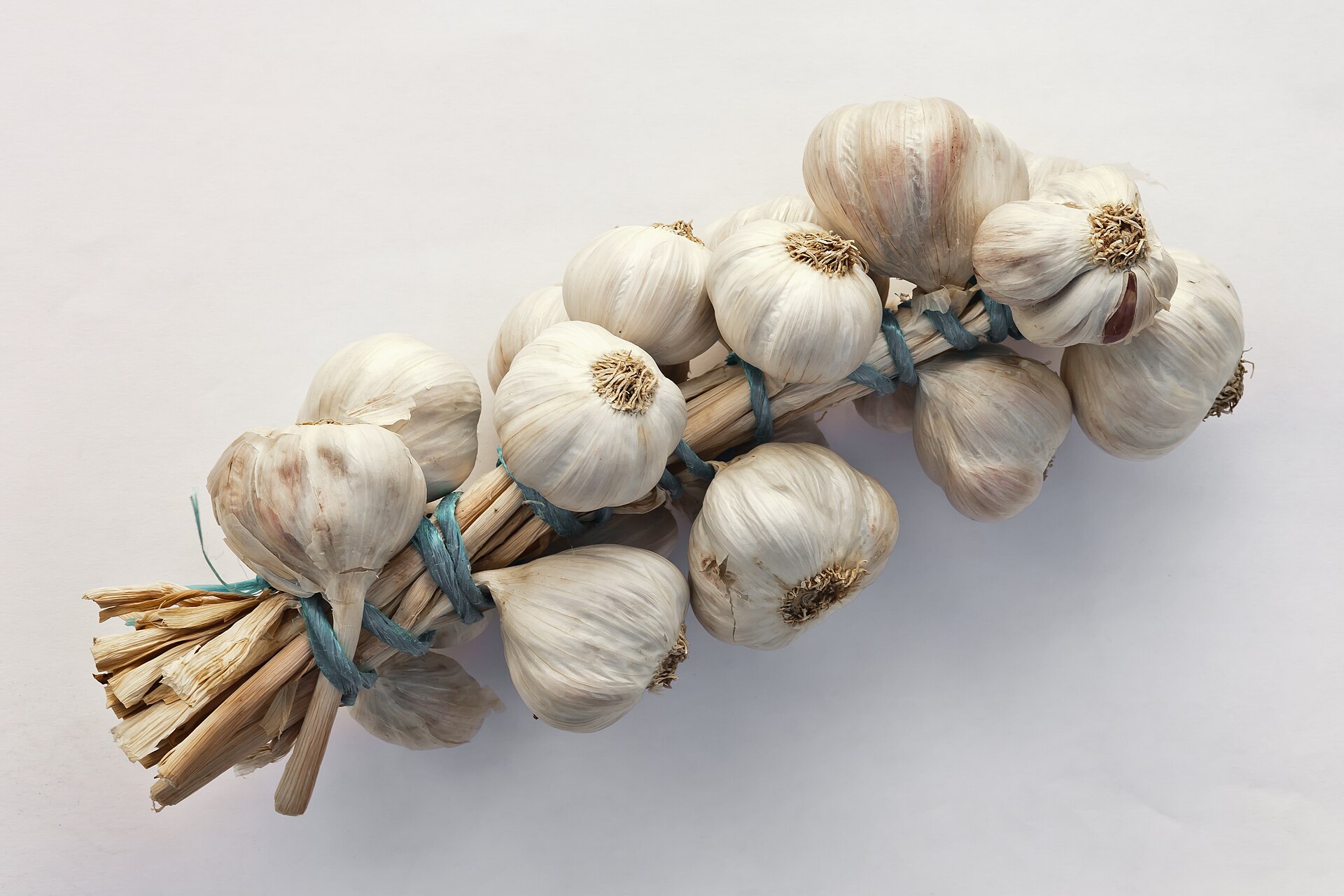
Bulb: made of individual cloves wrapped in papery skins. Plant cloves 2–3 inches deep in fall, and harvest in late spring or early summer when about half the leaves have turned brown [3].
Leaves: long, thin, and grass-like, brighter green than other cultivated alliums [3].
Stem and flower: a bare green flower stalk (scape) topped by a seed capsule. Gardeners often snip the scape to get bigger bulbs [3].
Smell: the unmistakable garlic and onion smell when cut or crushed.
Buying tips: fresh bulbs should be firm and dry. For supplements, check for Allium sativum on the label. U.S. supplements are not FDA-approved before sale, and contents can differ from the label [2][4].
❦
Look-alikes to avoid
When in doubt, don't.
If any feature doesn't match, or you can't check all of them, leave the plant alone. Only harvest wild alliums that have the distinct smell of onion or garlic[12], and even then, be certain of every other feature.
Store and garden garlic has no dangerous look-alike. The risk comes when foraging for wild garlic, wild onions, or ramps.
Field garlic (Allium vineale): edible, but know it
A common lawn weed from Europe, naturalized in much of the eastern U.S. It has thin, hollow, chive-like leaves that smell of garlic when crushed [12].
NC State Extension lists it as often confused with garden garlic. It's edible, but it can cause mild stomach upset (nausea, vomiting, diarrhea). NC State's rule: only harvest plants with the distinct onion smell [12].
Death camas (Toxicoscordion / Zigadenus species): poisonous
A native foothill and rangeland plant. Its bulbs can be mistaken for onions [8][9].
No onion smell. The bulbs lack any onion odor [8][9].
Flowers: small cream-colored to white or yellowish flowers along the stem, not a round onion-type cluster [8][9].
Stem and bulb: a solid stem, and a large bulb with a black coat [9].
Toxicity: all parts are poisonous. Symptoms can include vomiting, low heart rate and blood pressure, and paralysis [8][9].
Wild onion, by contrast, smells of garlic or onion, has a hollow stem and a round, umbrella-like flower cluster, and a smaller bulb with a brown, papery coat [9].
Lily-of-the-valley (Convallaria majalis) and false hellebore (Veratrum viride) vs. ramps (Allium tricoccum)
Ramps are a wild spring allium of eastern North American woods. NC State Extension says their strong garlic or onion smell distinguishes them from these poisonous look-alikes [7].
Lily-of-the-valley contains heart-affecting compounds (cardiac glycosides). It has paired basal leaves and small, white, nodding, bell-shaped flowers [14].
False hellebore is highly poisonous. Its leaves are strongly ribbed with parallel veins and clasp a stout, downy stem 2–6 feet tall, and it has yellow-green flowers [15].
Bleeding: garlic supplements may increase the risk of bleeding [2]. Tell your health care providers if you take them, especially before surgery or if you take blood thinners or aspirin [2]. EU guidance says to avoid garlic preparations for 7 days before surgery and to use them cautiously with blood thinners or anti-platelet drugs [6].
HIV medicines: EU guidance says garlic preparations must not be used with the HIV drugs saquinavir/ritonavir, because garlic can lower their levels and lead to treatment failure [6].
Common side effects: bad breath, body odor, belly pain, gas, and nausea [2].
Allergy: some people are allergic to garlic [2]. If you are, avoid related plants such as onion, leek, chives, hyacinth, and tulip [4].
Skin: handling garlic can cause contact dermatitis in some people [3]. Raw garlic can burn the skin [2].
Pregnancy and breastfeeding: garlic in food amounts is fine. Amounts larger than food may not be safe [2]. EU guidance does not recommend medicinal garlic in pregnancy or breastfeeding [6]. Garlic's smell passes into breast milk [4].
Children: EU guidance does not recommend medicinal garlic for the heart under age 18, or for colds under age 12, because of a lack of data [6].
Pets: NC State Extension lists garlic as a problem plant for cats, dogs, and horses. Poisoning signs include vomiting and damage to red blood cells [3].
Not medical advice
This page is for general education only. It is not medical advice and doesn't replace a doctor, pharmacist, or other qualified professional. Herbs can cause allergic reactions and interact with medicines. Check with a health professional before using any herb, especially if you are pregnant or breastfeeding, giving it to a child, taking medication, or managing a health condition. Never eat or use a wild plant unless an expert has confirmed what it is. For a suspected poisoning in the U.S., call Poison Help at 1-800-222-1222 [13]. In Canada, call 1-844-POISON-X (1-844-764-7669), or the Centre antipoison du Québec at 1-800-463-5060 if you are in Québec [16].
Ried K. Garlic lowers blood pressure in hypertensive individuals, regulates serum cholesterol, and stimulates immunity: an updated meta-analysis and review. J Nutr. 2016. https://pubmed.ncbi.nlm.nih.gov/26764326/