Dandelion is the familiar yellow lawn flower with a fluffy, wind-blown seed head. It's native to Europe and Asia and now grows across the temperate Northern Hemisphere, including most of North America [1][4][5]. Its deep taproot commonly reaches 6–18 inches, and a single plant can make up to 20,000 seeds [2]. Nearly every part is edible [2].
Dandelion has a long history as a food and folk medicine, especially for digestion and as a "water pill." European regulators accept it for mild digestive and urinary complaints, but only on the basis of traditional use [3][6]. NCCIH says there's "no compelling scientific evidence" for dandelion for any health condition [5].
Common names: dandelion, lion's tooth, pissenlit, priest's crown, and puffball [1][2].
Botanical name:Taraxacum officinale Weber ex Wigg. [3]. An older synonym is Leontodon taraxacum L. [1].
Family: Asteraceae, the daisy family [2][4]. Ragweed, chrysanthemums, marigolds, and daisies are in the same family [5].
Where the name comes from: "dandelion" comes from the French dent de lion, "lion's tooth," after the toothed leaves [1][4].
❦
Traditional uses
This section describes how people have used dandelion historically. It does not show that these uses work. See the next section for the evidence.
A long history: Arab physicians wrote about medicinal dandelion as early as the 10th century, and it appears in ancient Chinese texts [1]. The flowers, leaves, and root have been used in Mexican and other North American traditional medicine [5]. Dandelion is also part of some Indigenous herbal traditions [2].
Digestion and liver: traditionally used for the liver and gallbladder, as a mild laxative and "tonic," and for heartburn [1]. European regulators recognize dandelion root with herb as a traditional remedy for mild digestive problems, such as feeling full, gas, and slow digestion, and for temporary loss of appetite [6].
"Water pill": dandelion has long been used as a diuretic [1][2]. European regulators accept the leaf as a traditional way to increase urine and flush the urinary tract, alongside other treatment for minor urinary complaints [3].
Other folk uses: diabetes, bruises, rheumatism, gout, eczema and other skin problems, and cancer [1].
Food: in Appalachia and other rural parts of the United States, dandelion greens are a springtime food [2]. The roasted root was used as a coffee substitute during World War II [4].
❦
What the evidence says
Bottom line: there is very little human research. NCCIH says "we know very little about dandelion's effect on human health" [5]. Most studies are in test tubes or animals [1][5].
Use
What was found
Strength
Diuretic ("water pill")
In a one-day pilot study of 17 volunteers, a fresh-leaf extract increased how often people urinated after the first dose and increased urine output after the second. The third dose had no effect [8]. Drugs.com says clinical trials don't support this use despite its long tradition [1].
One tiny study
Digestion, liver, gallbladder
No clinical data in people [1]. The EU acceptance is based on traditional use only [6].
No human trials
Blood sugar
A single case report of low blood sugar in a woman with diabetes. Clinical trials are lacking [1].
Dandelion is said to increase milk supply, but no scientifically valid clinical trials support this [9].
No good evidence
What we can't say: that dandelion detoxes the liver, treats diabetes, lowers cholesterol, treats cancer, or helps joint pain [1][5]. It's a nutritious green, rich in beta-carotene, potassium, and other nutrients [1]. That's not the same as being a proven medicine.
❦
How it’s used / prepared
This is general, traditional information, not a recommendation or a dose for you. Talk with a health professional before using dandelion for a health purpose.
Food: young leaves are best raw in salads. Older leaves are better cooked like spinach. The flowers are used in salads, fritters, jelly, wine, and tea. The roots can be roasted for a coffee-like drink [2][4][10].
Tea: the EU traditional-use monographs describe teas (infusions or decoctions) of dried leaf, or of root with herb, for adults and adolescents. They aren't recommended under age 12 [3][6]. For the "water pill" use, the monographs say adequate fluid intake is needed [3][6].
When to stop and get help: EU guidance says to see a doctor if symptoms last more than 2 weeks, or if fever, painful urination, cramps, or blood in the urine appear [3][6].
Where to pick: only harvest dandelions you know haven't been sprayed with herbicides, and avoid roadsides, where plants may be contaminated. Wash them before eating [2]. Mississippi State Extension also advises avoiding power-line corridors and industrial areas, because plants can absorb pollutants from soil, water, and air [10].
❦
How to identify
Dandelion is one of the easiest wild plants to learn, but several "yellow dandelion-like flowers" grow in the same places. Check every feature below.
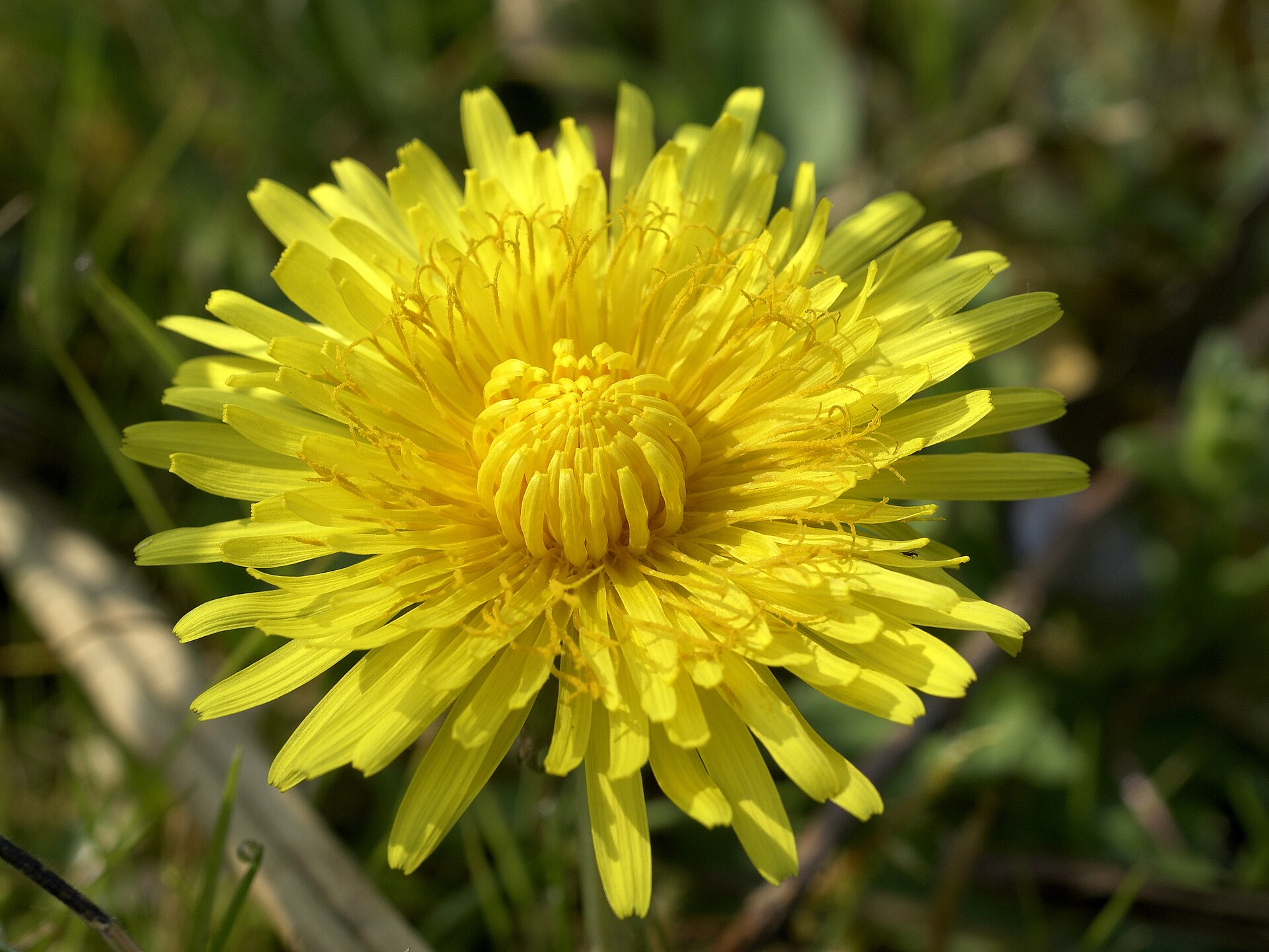
Leaves: all grow from the base in a flat rosette, with no leaves on the flower stem. They are deeply toothed, often with teeth or lobes that point back toward the center[4]. Leaf shape varies from nearly smooth-edged to deeply cut [1].
Flower stems:hollow, leafless, and unbranched, with one flower head per stem. They ooze a milky sap when broken [1][4].
Flowers: a single bright yellow head made only of strap-shaped "petals" (ray flowers) with toothed tips. Flowers close in the evening [1][4].
Seed head: a round, white, fluffy "puffball" of seeds carried by the wind [4].
Root: a thick taproot, commonly 6–18 inches deep [2].
Size: NC State Extension lists it as 2–6 inches tall [4]. Drugs.com says it can reach about 0.5 m (20 inches) [1].
Season: flowers mainly in spring, but can appear through much of the year [2][4].
Habitat and range: lawns, gardens, fields, and disturbed ground in full sun. It grows throughout the temperate Northern Hemisphere, including North America [1][4][5].
❦
Look-alikes to avoid
When in doubt, don't.
If any feature doesn't match, or you can't check all of them, leave the plant alone.
Dandelion has no deadly look-alikes in our verified sources. NC State Extension lists several plants often confused with it [4]. Most are edible relatives, but one common weed is toxic.
Common groundsel (Senecio vulgaris): toxic
A common garden and roadside weed in the daisy family, with small yellow, dandelion-like flower heads and fluffy seeds [7].
Toxicity: NC State Extension rates it medium-severity, with delayed effects that include lethargy, vomiting, and signs of liver failure [7].
How it differs: groundsel has a leafy, branching stem, with deeply lobed leaves growing along the stem. It produces many small flower heads in clusters, and the heads have no strap-shaped petals. Its stems are purple and hollow [7]. A dandelion's leaves are all at the base, and each leafless stem carries a single flower head [4].
Catsear (Hypochaeris radicata): edible, but not dandelion
It also has a basal rosette, milky sap, and wind-blown seeds, and its flowers are often mistaken for dandelions [12].
How it differs: its leaves are densely hairy. The flower stalks are wiry, often branched, and may carry a few small leaves. Its pale yellow flowers bloom from mid-summer to early fall [12].
NC State Extension lists catsear leaves as edible. It's a problem plant for horses [12].
Chicory (Cichorium intybus): edible
Its first-year rosette of rough, hairy leaves resembles dandelion [13].
How it differs: in its second year, it sends up wiry, branched stems 2–4 feet tall, with blue flowers along the stems [13].
Food amounts: eating dandelion in normal food amounts is considered likely safe. Less is known about larger amounts [5]. The FDA considers dandelion "generally recognized as safe" (GRAS) as a food [9].
Daisy-family allergy: EU guidance says not to use dandelion medicines if you're allergic to dandelion or any plant in the daisy family (Asteraceae) [3][6]. NCCIH notes the evidence on cross-reactions with ragweed and related plants is conflicting [5]. Allergic skin rashes, runny nose and itchy eyes, and asthma have been reported [1]. Topical dandelion may cause allergic reactions in people with eczema [5].
Who should avoid it: EU guidance says not to use dandelion medicines if you have blocked bile ducts, gallbladder inflammation or gallstones, liver disease, or an active stomach ulcer [3][6]. It also says people with kidney failure, diabetes, or heart failure should avoid them because of a possible risk of high potassium [3][6].
Stomach effects: stomach pain and excess stomach acid may occur [6]. Diarrhea and stomach upset are rare [9].
Medication interactions: EU regulators found none reported [3][6]. Drugs.com says none are well documented, but case reports suggest it might add to the effects of diabetes medicines and diuretics[1]. NCCIH says there are theoretical reasons it might interact with diabetes medicines, blood thinners, antiplatelet drugs, and water pills [5]. Ask your pharmacist before using dandelion as a supplement if you take any of these.
Very large amounts: one case report describes kidney-related problems (hyperoxaluria) after someone drank 2.4–3.5 liters of dandelion tea a day for 6 months [1].
Animal findings: reduced fertility has been seen in male rats. Whether this matters for people is unknown [1].
Pregnancy: little is known about amounts larger than food [5]. EU guidance does not recommend medicinal use in pregnancy [3][6].
Breastfeeding: use is unlikely to harm a breastfed baby. Its reputation for increasing milk supply isn't supported by valid trials [9]. EU guidance does not recommend medicinal use while breastfeeding [3][6].
Children: EU guidance does not recommend dandelion medicines under age 12 [3][6].
Pets: Oregon State Extension advises not growing dandelions to eat where cats and dogs can get to them [2].
Not medical advice
This page is for general education only. It is not medical advice and doesn't replace a doctor, pharmacist, or other qualified professional. Herbs can cause allergic reactions and interact with medicines. Check with a health professional before using any herb, especially if you are pregnant or breastfeeding, giving it to a child, taking medication, or managing a health condition. Never eat or use a wild plant unless an expert has confirmed what it is. For a suspected poisoning in the U.S., call Poison Help at 1-800-222-1222 [11]. In Canada, call 1-844-POISON-X (1-844-764-7669), or the Centre antipoison du Québec at 1-800-463-5060 if you are in Québec [14].
Clare BA, Conroy RS, Spelman K. The diuretic effect in human subjects of an extract of Taraxacum officinale folium over a single day. J Altern Complement Med. 2009. https://pubmed.ncbi.nlm.nih.gov/19678785/